
Front and Rear vs. 3-Channel Dash Cam: What's the Difference?
Shopping for a dash cam can feel overwhelming. Single-channel, dual-channel, 2-channel, 3-channel what do these terms actually mean, and which one do you need? If you've narrowed it down to multi-channel recording, you're likely choosing between a front-and-rear (2-channel) setup and a front-rear-cabin (3-channel) system. Understanding the real differences will help you invest in the right protection for your vehicle, your passengers, and your peace of mind.
What Is a 2-Channel (Front and Rear) Dash Cam?
A 2-channel dash cam uses two cameras: one mounted on the windshield facing forward, and a second camera facing backward usually mounted on the rear window or license plate area. Both cameras connect to a single main recording unit.
What it records:
-
Front camera: The road ahead, traffic conditions, accidents, and road signs
-
Rear camera: Vehicles behind you, rear-end collisions, and tailgating incidents
Best for:
-
Daily commuters and family vehicles
-
Drivers who primarily need road-facing evidence
-
Budget-conscious buyers who want solid protection without extra complexity
-
Those who don't need interior monitoring
2-channel dash cams are the most popular configuration because they cover the two highest-risk angles front and rear at a reasonable price point. Most quality 2-channel systems record at 4K front and 1080P rear, providing excellent evidence for insurance claims and accident documentation.
What Is a 3-Channel Dash Cam?
A 3-channel dash cam adds a third camera to the front-and-rear setup: an interior-facing camera that records everything happening inside the cabin. This third lens is typically integrated into the main front unit or mounted separately on the windshield.
What it records:
-
Front camera: Road ahead with high resolution (often 4K)
-
Rear camera: Traffic behind the vehicle
-
Interior camera: Driver, passengers, and cabin activity
Best for:
-
Rideshare and taxi drivers (Uber, Lyft)
-
Parents monitoring children in the back seat
-
Fleet operators needing driver accountability
-
Anyone wanting maximum protection against false claims
The interior camera is the defining feature. It transforms your dash cam from a road-recording device into a complete vehicle surveillance system.
The Core Differences at a Glance
| Feature | 2-Channel (Front + Rear) | 3-Channel (Front + Rear + Cabin) |
|---|---|---|
| Cameras | 2 | 3 |
| Coverage | Road ahead and behind | Road ahead, behind, and inside |
| Best For | Daily drivers, commuters | Rideshare, families, fleets |
| Price | Lower | Higher |
| Storage Needs | Moderate | Higher |
| Power Consumption | Standard | Higher |
| Installation | Simpler | More complex |
| Interior Evidence | None | Full cabin recording |
When a 2-Channel Dash Cam Is Enough
For the majority of drivers, a quality 2-channel system provides all the protection needed. Here's when front-and-rear coverage is sufficient:
Daily Commuting If you drive to work, run errands, and occasionally take road trips, front and rear cameras capture the angles where 90% of accidents occur. Rear-end collisions and intersection incidents are fully documented.
Family Vehicles Parents driving kids to school don't typically need interior recording. The front and rear cameras protect against road accidents and parking lot incidents. If you need to check on children, a rearview mirror or baby mirror works fine.
Budget-Conscious Buyers 2-channel systems cost less and require smaller memory cards. You'll spend less upfront and less on ongoing storage. A 64GB card often suffices for 2-channel recording with loop overwrite.
Simple Installation With only two cameras to mount and one cable to run to the rear, 2-channel systems install faster and create less interior clutter. Most drivers can self-install in under an hour.
When You Need a 3-Channel Dash Cam
The third camera isn't just an add-on it's a fundamentally different level of protection. Here's when 3-channel coverage becomes essential:
Rideshare and Taxi Driving Uber and Lyft drivers face unique risks: passenger disputes, false accusations, and in-car incidents. The interior camera provides irrefutable evidence of passenger behavior, protecting drivers from fraudulent claims and account deactivation.
Monitoring Teen Drivers Parents of new drivers can review interior footage to ensure safe driving habits seatbelt use, phone distraction, and passenger behavior while the front and rear cameras document road incidents.
Fleet and Commercial Vehicles Business owners use 3-channel systems to monitor driver behavior, ensure cargo security, and protect against liability claims. The interior camera proves drivers were attentive and following protocols.
Complete Peace of Mind If you simply want maximum protection, a 3-channel system leaves no gaps. Whether it's a road accident, a parking lot hit-and-run, or an in-car dispute, every angle is covered.
Resolution Trade-Offs: What the Experts Say
One critical consideration: running three cameras simultaneously can impact front camera resolution. Some dash cams advertise 4K front recording, but when all three channels are active, that resolution drops to 2K or 1440p to manage processing demands.
For example, the Vantrue N4 offers 4K front recording—but only when used as a single camera. With all three channels active, front resolution falls to 1440p while rear and interior record at 1080p.
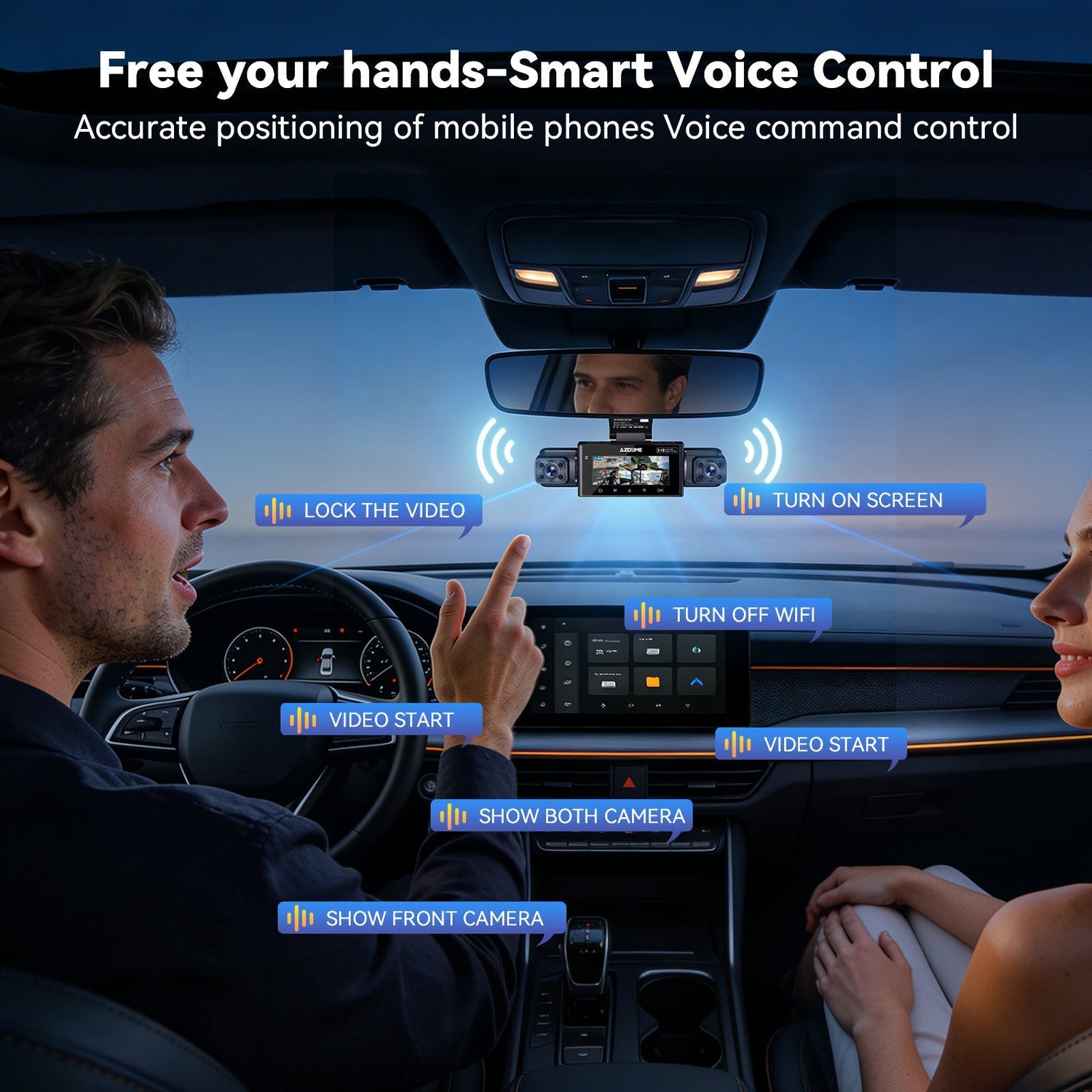
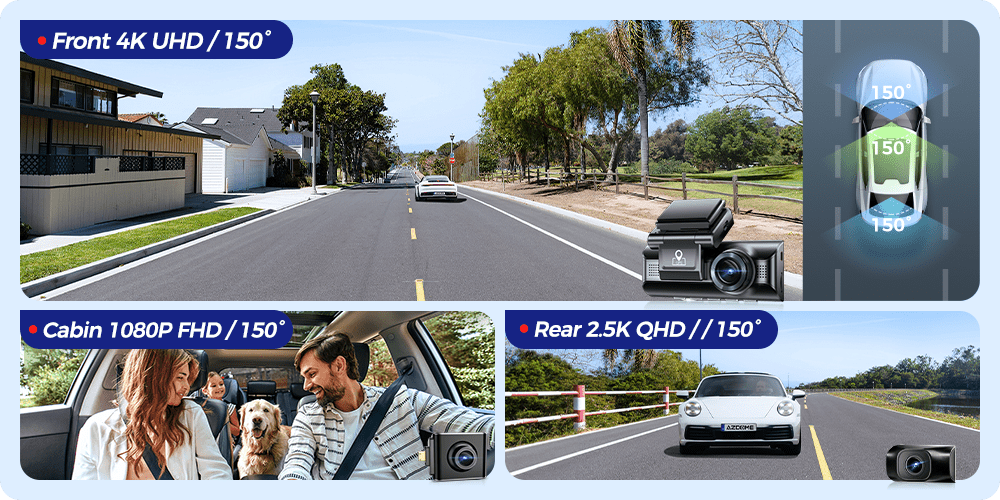
AZDOME's approach with the M550 Max is different. The M550 Max maintains 4K front resolution across all 1-channel, 2-channel, and 3-channel configurations—meaning you get full 4K clarity even when all three cameras are recording simultaneously.
This is achieved through efficient processing and dedicated bandwidth allocation, ensuring no resolution compromise when you need complete coverage.
Storage and Power Considerations
3-channel systems demand more from your vehicle's resources. Here's what to expect:
Storage Requirements Recording three video feeds simultaneously generates significantly more data. While a 2-channel system might use 8-10GB per hour, a 3-channel 4K system can consume 20-26GB per hour.
| Setup | Approx. Storage per Hour | Recommended Card |
|---|---|---|
| 2-Channel (4K + 1080P) | ~10-12 GB | 64-128GB |
| 3-Channel (4K + 2.5K + 1080P) | ~20-26 GB | 128-256GB |
The AZDOME M550 Max includes a 64GB high-endurance card to get you started, with support for up to 256GB for drivers who want extended recording history.
Power Consumption Three cameras draw more power than two. If you use parking mode, a 3-channel system will drain your car battery faster without proper power management. AZDOME solves this with supercapacitor technology instead of lithium batteries—supercapacitors handle temperature extremes better and provide reliable parking mode protection without the fire risk of traditional batteries.
Key Features to Compare
When evaluating 2-channel vs 3-channel systems, look beyond the camera count:
Night Vision
-
2-channel: Front camera WDR and rear camera low-light sensors
-
3-channel: Adds infrared (IR) LEDs for the interior camera, enabling clear cabin recording in complete darkness—critical for rideshare drivers working night shifts
GPS Integration
-
Both configurations benefit from built-in GPS, but it's especially valuable for 3-channel systems used by rideshare drivers who need to prove location and speed during disputes. The M550 Max includes built-in GPS with speed and route logging.
WiFi Connectivity
-
3-channel systems generate more footage, making fast file transfers essential. The M550 Max features 5G WiFi for rapid downloads via the AZDOME app no card removal required.
Parking Mode
-
Both configurations support parking mode with hardwiring, but 3-channel systems offer more comprehensive surveillance. The M550 Max includes 24-hour parking monitoring with motion detection across all three cameras.
Installation: What to Expect
2-Channel Installation
-
Mount front camera behind rearview mirror
-
Route cable to rear camera (tucked along headliner and pillars)
-
Plug into 12V outlet or hardwire to fuse box
-
Typical time: 30-60 minutes
3-Channel Installation
-
Same front and rear camera mounting
-
Interior camera integrated into main unit (no extra mounting needed on M550 Max)
-
Same power connection, but verify your vehicle's electrical system can handle parking mode draw
-
Typical time: 45-75 minutes
The M550 Max's integrated interior camera simplifies installation—no separate cabin camera to mount, no extra cables to run. The third lens is built into the main unit, positioned to capture the driver and passenger area naturally.
The Verdict: Which Should You Choose?
Choose a 2-Channel Dash Cam If:
-
You're a daily commuter or family driver
-
Budget is a primary concern
-
You don't need interior monitoring
-
You want simpler installation and lower storage costs
-
Front and rear road coverage is sufficient for your needs
Choose a 3-Channel Dash Cam If:
-
You drive for Uber, Lyft, or a taxi service
-
You need to monitor passenger behavior
-
You're a parent of a teen driver
-
You operate a fleet or commercial vehicle
-
You want the most comprehensive protection available
-
You can accommodate higher storage and power requirements
AZDOME's Solutions for Both Needs
For 2-Channel Drivers: M300S
-
4K front recording with 170° wide-angle view
-
1080P rear camera
-
Built-in GPS and WiFi
-
Compact, discreet design
-
Perfect for daily drivers who want premium road coverage
For 3-Channel Drivers: M550 Max
-
4K front + 2.5K rear + 1080P cabin all recording simultaneously
-
6 IR LEDs for invisible cabin night vision
-
Dual Starvis sensors with WDR for superior low-light performance
-
Built-in GPS & 5G WiFi for instant location tracking and file sharing
-
64GB card included ready to record out of the box
-
IP68 waterproof rear camera for all-weather reliability
-
Supercapacitor power for safe, reliable operation
The M550 Max delivers the complete 3-channel protection that rideshare drivers, fleet operators, and security-conscious drivers demand without the resolution compromises common in competing systems.
Article Summary & Key Differences
|
Feature / Aspect |
Dual-Channel (Front & Rear) |
3-Channel (Front, Rear & Cabin) |
|
Coverage Scope |
Front road and rear bumper view |
Complete 360° front, rear, and interior cabin view |
|
Best Used For |
Daily commuters, highway driving, family cars |
Rideshare drivers (Uber/Lyft), fleet safety, full interior security |
|
Interior Night Vision |
Not included |
Infrared (IR) LEDs for clear cabin recording in complete darkness |
|
Installation Complexity |
Simple 2-camera cable routing |
3-camera setup (or combined front+cabin main unit with rear cable) |
Final Thoughts
The difference between a 2-channel and 3-channel dash cam comes down to one question: Do you need to see inside your vehicle? If the answer is yes—for rideshare work, family monitoring, or maximum security a 3-channel system is the clear choice. If road-facing evidence is all you need, a quality 2-channel system provides excellent protection at a lower cost.
At AZDOME, we build both configurations with the same commitment to quality: Sony-grade sensors, built-in GPS, WiFi connectivity, and the reliability your safety depends on. Whether you choose the road-focused M300S or the all-seeing M550 Max, you're getting professional-grade protection engineered for real-world driving.
Ready to choose your coverage? Explore AZDOME's complete dash cam lineup at azdomevip.com and drive with confidence from every angle.
Drive safe. Record everything. Trust AZDOME.


コメントを書く
このサイトはhCaptchaによって保護されており、hCaptchaプライバシーポリシーおよび利用規約が適用されます。